Cycling on Long Island: The Safety + Legal Guide for 2026
A practical guide to cycling safely on Long Island — best routes, the most dangerous stretches to avoid, NY bike law, what to do if you're in a crash, and how to get back on the road with confidence.

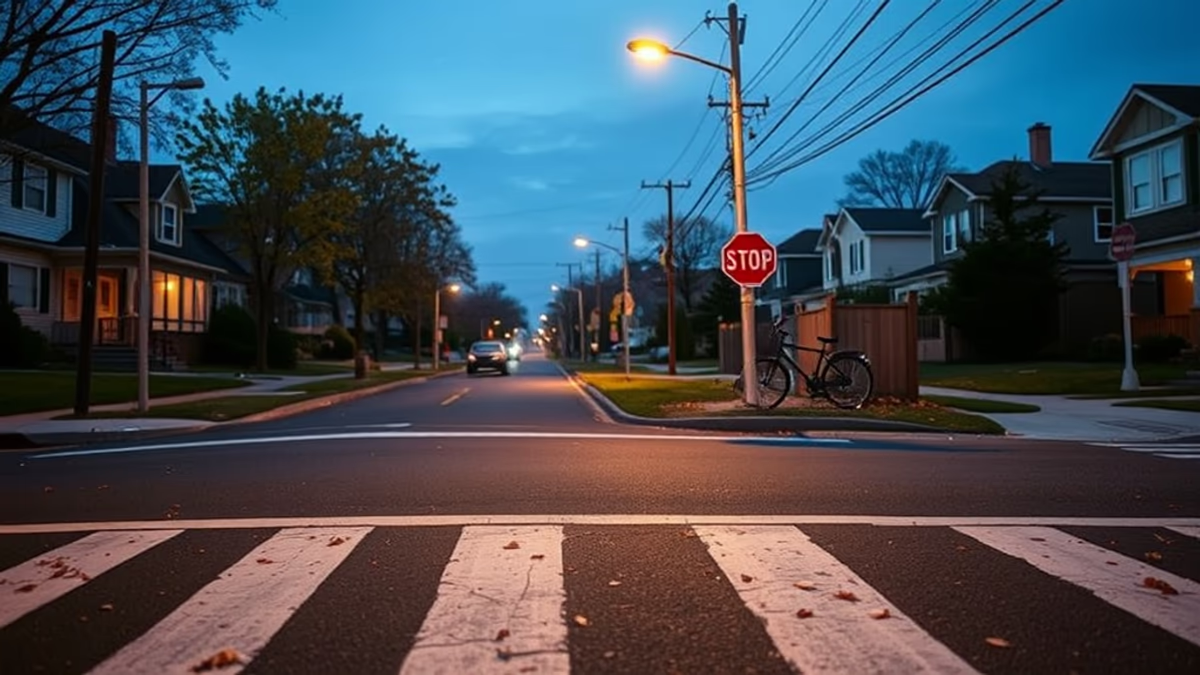
Cycling on Long Island in 2026
Long Island is a frustrating cycling destination. The infrastructure investment of the last decade — the Bethpage Bikeway corridor, the Greenway trail system from Hempstead Lake to Long Beach, the Wantagh State Parkway path — has built genuinely excellent recreational riding. But the road network connecting these resources, and the arterials cyclists need to use for commuting, are largely hostile.
This guide covers what works (route by route), what doesn’t (corridors to avoid), the New York bike laws that actually apply, and what to do in the worst-case scenario — a collision with a vehicle.
It’s not legal advice. For your specific situation, consult a licensed attorney.
The routes worth knowing
Recreational + scenic (low-stress)
Bethpage Bikeway corridor (north-south spine)
- The most extensive protected cycling infrastructure on Long Island. ~15 miles connecting Bethpage State Park through to South Shore parks.
- Smooth pavement, dedicated lanes, multiple access points
- Best for: families, road bikes, anyone wanting low-stress miles
- Avoid: rush hour weekday afternoons (commuter density on the southern segments)
Wantagh State Parkway path (north-south, parallel to parkway)
- ~5 miles from Hempstead to Jones Beach. Connects to Greenway.
- Fully separated from vehicle traffic. Beach destination at the south end.
- Best for: summer rides, family outings, beach-day cycling
Greenway (Hempstead to Long Beach)
- ~9 miles. Multi-use trail, beach-direction commuter route.
- Connects Eisenhower Park to the Atlantic boardwalk.
East End scenic routes
- North Fork Route 25 from Cutchogue to Greenport — gorgeous, low-traffic except summer weekends
- Shelter Island loops — accessible via ferry from Greenport or North Haven
- Montauk-Amagansett coastline — early mornings only; summer afternoons are dangerous
Commuter / road riding
Routes that work in practice (cyclists report comfortable):
- North Country Road through Stony Brook to Setauket — wide shoulders, slower speeds
- Old Country Road in Nassau (segments) — varies by town; check for current bike lane status
- Lewis Road / Hampton Bays back roads — light traffic, scenic
- South Shore village interconnects (Sayville-Bayport-Bay Shore-Babylon) — variable, but generally village-paced
Routes to AVOID when alternatives exist:
- Sunrise Highway / Route 27 — no shoulder in many sections, 50+ mph traffic
- Hempstead Turnpike (Route 24) — multi-lane, high turning conflicts
- Jericho Turnpike (Route 25) — particularly through Huntington Station / Commack
- Route 110 — Walt Whitman Mall corridor, parking-lot exits, no shoulder
- All Long Island Expressway service roads — fast traffic, frequent merges
Long-distance / event riding
Recurring annual events worth scheduling around:
- Long Island Bicycle Club summer century rides (multiple per year)
- Tour de Long Island (charity, fall)
- Suffolk County Greenway Festival
- Bike Tour of the Hamptons (fall, fundraiser)
NY State bike law (what actually applies)
New York Vehicle and Traffic Law treats bicycles as vehicles when they’re in the road. The practical rules:
As a cyclist, you MUST:
- Ride with traffic (in the same direction as cars), never against it
- Use bike lanes where provided — except when avoiding obstacles or turning left
- Obey all traffic control devices (red lights, stop signs)
- Use lights at night: white front, red rear. Reflectors are NOT a substitute.
- Wear a helmet under age 14 (state law). Above 14 it’s not legally required but is strongly recommended.
As a cyclist, you HAVE the right to:
- Use the full lane when conditions make sharing dangerous (narrow roads, debris, parked-car door zones)
- Take the lane approaching intersections to prevent right-hook collisions
- Three-foot passing buffer from overtaking vehicles (NY law)
- Refuse to ride on sidewalks in business districts (where banned by local ordinance) — you have the right to the road
What drivers MUST do around you:
- Pass at a safe distance (NY law: at least 3 feet, often described as “safe and prudent distance”)
- Yield at right turns when a cyclist is in their path or close enough to constitute danger
- Check for cyclists before opening doors (“Dooring” is the driver’s fault under NY case law)
- Yield at crosswalks even when a cyclist is walking the bike across (treated as a pedestrian in that moment)
The legal grey zone: shoulders and bike lanes
NY law is clear that bicycles have the right to use the road. It’s less clear on the question of mandatory bike-lane use. The practical interpretation:
- If a bike lane is present, in good condition, and reasonably safe, use it
- If a bike lane is glass-strewn, occupied by parked cars, or makes a right-hook intersection more dangerous, you can lawfully use the regular lane
- “Sidewalk riding” is banned by local ordinance in many NY villages (Huntington, Babylon, Patchogue all ban it in their downtown business districts)
Defensive cycling — what actually works
Visibility (the highest-ROI investment)
- Daytime running lights front + rear, ALWAYS. Studies consistently show 30-50% reductions in passing-too-close incidents.
- High-contrast helmet + jersey colors. Reflective ankle bands (your legs move and catch attention).
- Rear-view mirror (handlebar or helmet-mounted). The ability to see overtaking traffic without head-turning changes your situational awareness.
Positioning
- Take the lane in narrow + door-zone conditions. Hugging the curb invites unsafe passes. Riding 3-4 feet from parked cars puts you out of the door zone.
- Stop at the head of the line at lights — visible to all turning traffic, gets you across the intersection ahead of acceleration zone.
- Hand signals at every turn, even when you think no one’s watching. Habit + visibility.
Where to ride
- Use protected infrastructure when possible (Bethpage, Greenway, Wantagh path)
- Pick routes ONE level less busy than the obvious one — parallel side streets instead of the main arterial
- Time-of-day awareness: 7-9 AM and 4-6 PM are commuter peak — highest risk on shared roads. Recreational ride at 6 AM Saturday is dramatically safer than 10 AM Saturday.
What to carry
- Multitool + spare tube + tire levers (no AAA for cyclists)
- Phone with a tracker app on (Strava, Garmin Live Track, or Apple Find My share with a loved one)
- ID + a small amount of cash + insurance card if you’re hit
- Water + something to eat if you’re going more than 20 miles
If you’re in a bike-vehicle collision
At the scene
- Get to safety first if you're in a live traffic lane. Move only as much as necessary to be out of further danger.
- Stay down if there's ANY head/neck-injury suspicion. Helmet impact + concussion is common and underdiagnosed in cycling crashes. Wait for EMS even if you feel "fine."
- Call 911 — always. For your safety AND because the police report is the foundational legal document for any subsequent claim.
- Get the driver's information — driver license, insurance, plate. Photograph all three.
- Photograph the scene — your bike position, the vehicle, road conditions, debris, traffic controls, your visible injuries.
- Get witness contact — name + phone. Witnesses scatter within minutes.
- Photograph bike damage before it's moved. Frame-bend angle, wheel impact pattern, helmet damage — these tell the story of impact direction + speed for the case file.
- Don't admit fault. Cyclists are routinely blamed in initial driver statements; let physical evidence speak.
Within 24 hours
- See a doctor. ER if you have any cognitive symptoms or significant pain. Concussion is the most underdiagnosed cycling injury. Even if you walked away, get evaluated.
- Report to the driver’s insurance (use the policy info from the police report). Do NOT give a recorded statement until you’ve spoken with an attorney — same rule as pedestrian cases.
- Document everything in writing. Pain levels, sleep impact, ability to work, ability to ride. Daily journal.
Within 48 hours
- Consult a personal injury attorney. As a cyclist hit by a vehicle, you have access to the driver’s no-fault (PIP) coverage AND potentially a third-party claim. For a free legal consultation on a Long Island bicycle case, our network firm can walk you through the options at no cost.
- No-fault coverage: Same as pedestrian cases — the driver’s no-fault policy covers your medical bills + lost wages up to $50,000 regardless of fault. This is true even if the driver was uninsured (you can claim against your own auto policy’s no-fault even if you weren’t driving a car at the time of the incident, as long as you own one).
- Bike replacement: a totaled bike is real property damage. Most personal-injury settlements include bike replacement; the driver’s collision/property-damage coverage applies. Keep receipts.
- Medical specialists: head injury → neurologist + concussion specialist. Soft-tissue → orthopedic. Persistent pain → physiatry / pain management. Document referrals.
NY-specific things to know
- Cyclists are NOT pedestrians under NY no-fault law. They’re treated under the driver’s PIP policy as if they were occupants of the vehicle that struck them.
- Helmet use does NOT reduce your right to recover damages. NY courts have ruled that not wearing a helmet doesn’t constitute “comparative negligence” for the incident itself, though it may affect damages for head injuries specifically.
- The “Dead Red” law (NY VTL § 1117(a)) — cyclists at an intersection where the traffic signal sensor doesn’t detect them may proceed cautiously through a red after stopping and verifying it’s clear. This is a defense against red-light tickets, not a permission to roll lights.
- Three-foot passing law (NY VTL § 1146-a) — drivers must pass cyclists at a safe distance, generally interpreted as at least 3 feet. Violations are summons-able.
Reporting + records
- Suffolk County Police non-emergency: 631-852-2677
- Nassau County Police non-emergency: 516-573-7000
- NYC bike crash reporting (if the incident occurred in Queens/Brooklyn): 311 or NYPD 311
- DMV accident report (MV-104): required within 10 days for injury or $1,000+ damage. As a cyclist hit by a vehicle, the driver files; you should file your own version too.
What we’d want you to remember
- Visibility is the single best investment. Daytime running lights, contrasting clothing, mirror.
- Take the lane when needed. The legal right is yours; using it correctly is safer than hugging the gutter.
- If you crash, don’t move if you can’t be sure of injury. Don’t admit fault. Get the report filed.
- NY no-fault covers cyclists. Even if the driver was uninsured. Even if you didn’t have car insurance. Use it.
- The first 48 hours are critical. Doctor, documentation, attorney consultation.
Related guides
- Pedestrian Safety + Legal Guide for Long Island — sister guide on walker safety
- Long Island bicycle-friendly events + group rides
- Concert-Going Safety on Long Island — venue + parking + late-night transit
Last updated by The Editors on May 25, 2026. We update this guide annually. Cycling safety corrections to corrections@thislongisland.com. This guide is informational, not legal advice — for your specific situation, consult a licensed attorney.
Upcoming in Huntington
- Sep 21 Huntington Village New York Murder Mystery Pub Crawl Paramount · Huntington
- Sep 24 Cocktails & Chromosomes Six Harbors Brewing Company · Huntington
- Oct 1 Singles Wine/Cheese Mingle + Country Western Dance Lesson Huntington The Ballroom of Huntington · Huntington
- Nov 19 Cocktails & Chromosomes Six Harbors Brewing Company · Huntington